
Hotel group bookings are reservations for multiple rooms at one property, held under a contracted rate for a specific event. Unlike booking rooms one at a time, a group reservation comes with negotiated terms, attrition clauses, and cutoff dates that tie every part of the process together: hotel contracts, attendee communications, check-in coordination, and post-event reconciliation.
Group reservations move real money. Undersize the block and you lose revenue to travelers who book elsewhere. Oversize it, and you pay attrition penalties on rooms nobody slept in.
This guide walks through how group hotel bookings actually work and how to manage the full process from contract to closeout.
Most hotels set the group threshold at nine or more rooms. Some properties start at five. Either way, what triggers group status is the contract, not the headcount.
Group rates are negotiated in advance and written into an agreement that governs every reservation in the block, including the terms that apply if pickup falls short.
A few specifics apply to professional group hotel bookings:
Not all group bookings work the same way. A small family reunion might get a courtesy hold with no formal contract. Weddings, youth sports tournaments, conferences, and corporate events are different.
They involve negotiated rebates, attrition clauses, compliance tracking, and pickup reporting that shape how housing managers plan blocks, communicate with attendees, and close out contracts.
Group hotel bookings cover a wide range of events, but the structure varies depending on who is running the event.
Some involve fully contracted blocks with attrition clauses and post-event reconciliation. Others run on courtesy blocks or live hotel inventory booking sites with no formal commitment.
Knowing which structure applies determines how you negotiate, what terms you accept, and how much financial exposure you carry.
Youth sports tournaments are one of the most consistent sources of group hotel demand in the country. Block sizing scales with team count, and proximity to the venue drives everything. Teams want short drives between the hotel and the field. Coaches want a predictable check-in. Parents want pools and breakfast.
Most competitive youth tournaments enforce Stay to Play compliance, where teams must book inside the official block to participate. That policy protects the room night guarantees that fund commission revenue for housing companies. Without it, teams book elsewhere, leading to noncompliance, and the contract underperforms.
Corporate events, conferences, and executive corporate retreats put different demands on a group hotel booking. Block sizing tends to track registration more tightly. Properties need real meeting space, meeting rooms, and business centers onsite. Schedules run tight, so hotels also need fast check-in, reliable WiFi, and catering options that work for business groups.
The contract often includes complimentary services like AV, room blocks paired with meeting space, and customizable setups. The room rate is rarely the most important line item.
What hotels charge for event space is usually tied to how many sleeping rooms you fill, which is why the two get negotiated together.
Weddings and family reunions typically involve a courtesy block or a group code rather than a fully contracted room block. For smaller gatherings, the volume rarely justifies attrition exposure, so hotels accommodate these groups without formal commitment terms.
Even on a courtesy hold, booking a hotel block for a wedding still rewards a little structure, since one shared link keeps guests together and shows the couple who has reserved.
Hotels competing for this business tend to lead with amenities: pools, on-site dining, and event space. Room nights concentrate around one or two nights, and the families booking want the property to feel like part of the celebration.
Educational trips for students and faculty prioritize safety, affordability, and proximity to learning sites. Block sizing varies widely. Some schools run small courtesy blocks at one property, while large district trips or national academic competitions contract real blocks with chaperone room ratios written into the agreement.
Hotels chosen for educational groups typically offer secure environments, group dining options, and quiet study areas.
Music and cultural festivals, concerts, and conventions compress demand into a short window, often one to three nights, which puts pressure on both room availability and rate. Groups that wait to contract often find inventory gone or prices significantly higher than they would have secured through a negotiated block.
Proximity to the venue is the primary driver of hotel selection. Attendees are less flexible on location than they are on amenities, which shifts the negotiating dynamic compared to events like weddings or tournaments.
Group hotel bookings are not one transaction. They are a lifecycle with eight distinct stages, and operators who run group hotel bookings at scale treat it that way.
Miss a cutoff and the contracted inventory vanishes. Skip reconciliation, and the hotel invoices the wrong amount. Run the process out of a spreadsheet, and both happen more than once. EventPipe is built around this lifecycle, so none of these stages get dropped.
See it in action. Request a demo of EventPipe.

Booking hotel rooms for a group starts with sizing the contract on real pickup data and ends with reconciling what was actually filled.
Getting that block size right is the first lever in any group hotel booking, because every stage that follows inherits the numbers you set at the start.
For a recurring event, pull history from prior years. For a new event, start conservatively. It is easier to add rooms mid-contract than to pay attrition penalties on empty inventory.
One hotel is not a competition. Three to five is. Competition drives real movement on group rates, discounts, and amenities like free breakfast, parking, meeting space, and complimentary rooms for organizers.
The rate matters, but so do the cutoff date, attrition percentage, cancellation terms, and complimentary room ratios. Push on all of them.
Travelers book from one place. No confusion about which property, rate, or link to use. Without a centralized site, bookings scatter across direct calls and third-party links, and pickup reporting becomes unreliable.
People cancel, extend, modify special requests, and swap rooms. You need visibility into every reservation and the ability to adjust inventory in real time.
Compare contracted rooms to rooms actually stayed in. That number determines the commission and rebate you invoice.
Factors to consider when booking hotels for a group include proximity to the venue, block size, cutoff date, attrition terms, amenities, cancellation policy, and booking site capability.
Details matter more than the rate. A low rate inside a punishing attrition clause costs more than a fair rate with reasonable terms.
To negotiate favorable group hotel rates and terms, use competing RFPs, bring pickup data from prior events, and push for discounts and amenities alongside the rate.
Contract six to twelve months out for major meetings, conferences, and tournaments. Last-minute planning gives leverage to the hotel.
If a large group filled 88 percent of a 400-room block last year, that data gives you standing to negotiate the same block this year. If you do not have data, say so and negotiate conservatively.
Complimentary rooms per block size, upgrades, waived resort fees, free breakfast, discounted parking, and favorable attrition percentages. A one-dollar-per-night rate cut is worth less than a relaxed attrition clause on a 200-room block.
Most contracts hold the group to 80 or 85 percent of the contracted block. Some include slippage allowances. Some let walk-in reservations count toward performance. Buyers who only look at the rate miss the clauses that actually cost money.
A bad contract costs more than an unfilled block. If the terms do not work, go elsewhere.
For a deeper look at contract language that favors the buyer, see the guide to writing a strong hotel RFP.
Stay to Play compliance is a policy used in youth sports tournaments that requires teams to book accommodations at officially designated hotels or risk being denied entry. It protects the room night guarantees that underwrite commission agreements between housing companies and hotels.
Youth and amateur sports generate significant lodging volume. Sports ETA's 2026 State of the Industry Report documented 339 million sports travelers generating 124.3 million room nights in 2025, which makes compliance enforcement commercially critical for any housing company running tournament programs.
The risk is what EventPipe calls blockflation. Teams over-reserve rooms to lock in inventory, inflating the apparent block size. When reservations convert to actual stays, pickup falls short, attrition fees trigger, and commission revenue collapses.
Teams Management tracks which teams have booked, how many rooms each holds, and whether every team sits inside compliance. It connects housing and registration data, so compliance shows up in real time rather than at reconciliation.
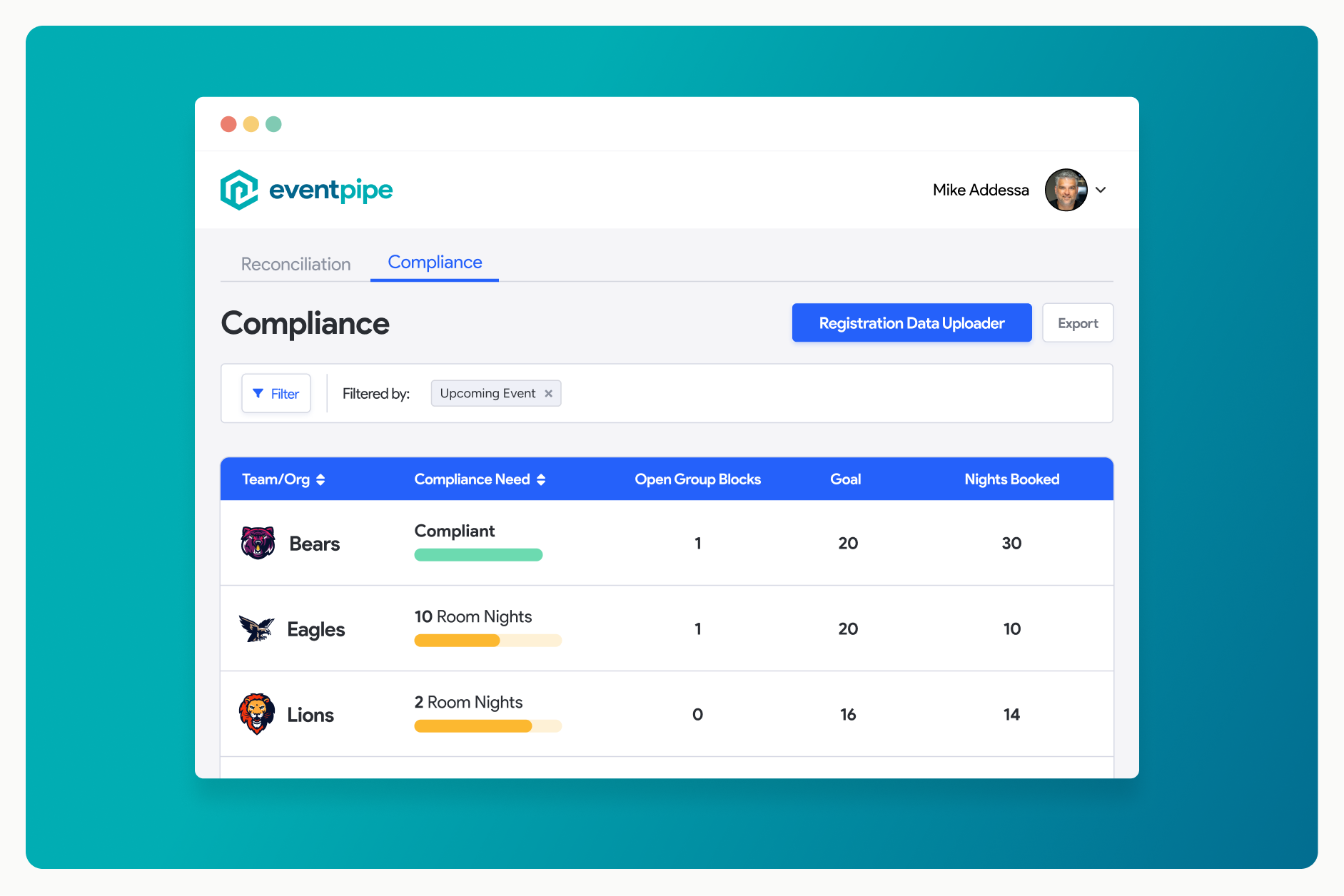
See how EventPipe handles stay-to-play compliance. Book a demo.
The best way to manage and track group hotel reservations is with purpose-built event housing software that covers the full booking process from RFP to invoicing.
General travel tools and spreadsheets break down once a housing company is managing multiple events simultaneously, across several hotels each: missed cutoffs, pickup data living in email threads, and reconciliation errors that surface weeks after the event closes.
Which tool fits depends less on feature count than on the inventory model underneath it, which is how our review of the best group hotel booking platforms sorts them.
Purpose-built event housing software covers the full process from RFP to invoicing. The capabilities that matter most:
Manual tracking costs housing companies time they do not have. Spreadsheet exports and VLOOKUPs between systems create errors that surface in reconciliation three weeks later. Event housing management software built for this lifecycle keeps every reservation, every hotel, and every event in one place.
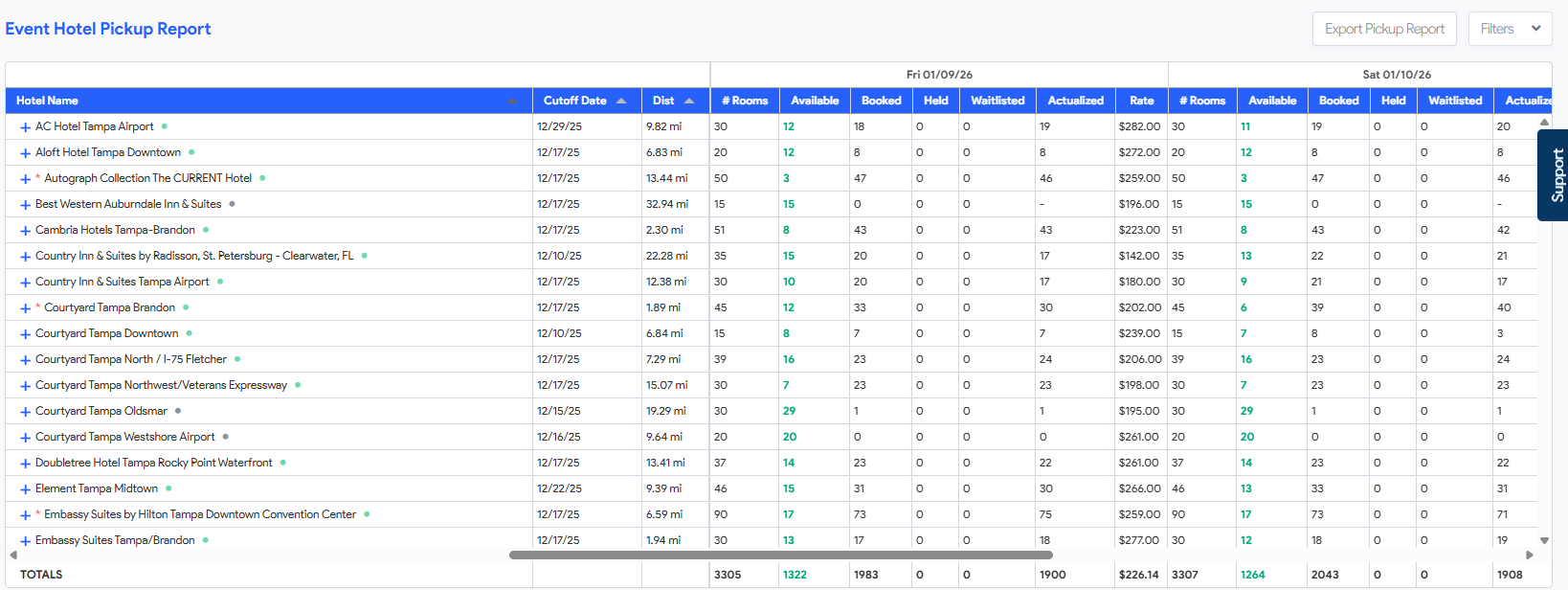
A contracted block is not always the right fit for group hotel bookings. Associations that overflow their blocks, events with unpredictable attendance, and smaller events where a full room block contract does not make sense can use live inventory booking instead.
EventPipe's Presto connects directly to live hotel inventory without a contract. Two scenarios where it fits:
Post-block is where Presto earns its place. Associations and business groups that overflow their convention room blocks every year leave commission dollars on the table when travelers book elsewhere.
“Event organizers should decide based on how confident they are in their demand and how much risk they want to take on. Contracted blocks make sense when you have strong historical pickup and need to lock in inventory, especially in compressed markets. Live inventory options like Presto are a better fit when demand is less predictable or booking behavior is more spread out, since they keep things flexible and avoid attrition risk.
The simplest way to think about it: if you can reliably forecast your room nights, commit to a block. If you can’t, stay flexible. Some events end up somewhere in the middle, using a small core block for base demand and live inventory to handle the rest.”
Josh Silverberg, Product Manager at EventPipe
Hotel group rates are most often cheaper than typical rates. For more in-depth information, you can use EventPipe’s hotel search function to see the exact savings you can access.
Most hotels will consider 9 or more rooms a group booking. However, some specialty hotels will consider at 5. This can vary by hotel.
Yes, there are often discounts for group hotel bookings, since it ensures them more business and fills more rooms at once. The size of the discount can depend on various factors such as the number of rooms being booked, the duration of the stay, the time of year, the hotel's policies, and more.
An attrition clause holds the group responsible if it does not fill a minimum percentage of the contracted block, usually 80 to 85 percent. If the block is 200 rooms at 85 percent attrition and the group only fills 150, you owe the difference at the group rate. It is the most important clause to understand before signing.
You pay attrition on the rooms that did not fill, up to the maximum number set in the contract. Some contracts allow slippage, meaning a portion can be released before the cutoff without penalty. Others let walk-ins count toward performance. Terms going in determine whether a soft pickup is minor or a five-figure invoice. Take the manual work out of group hotel booking. Request a demo of EventPipe.